
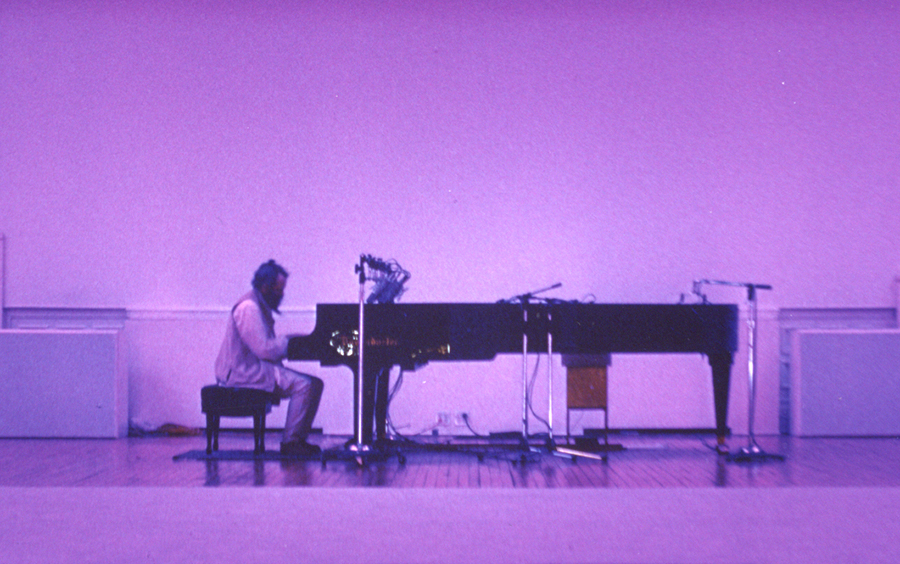
 Copyright © La Monte Young & Marian Zazeela 1987
La Monte Young 91st Birthday Celebration
Concert of Pre-recorded Tape
La Monte Young Marian
Zazeela
The Well-Tuned Piano
in
The Magenta Lights
“87 V 10 6:43:00 PM — 87 V 11 1:07:45 AM
NYC”
Sunday, October 18, 2026, 2 PM
MELA
Foundation Dream House
275 Church Street, 3rd Floor, New York
Admission $39. MELA Members, Seniors, Student ID, $31.
Limited seating. Advance reservations/ticket purchases recommended.
Doors open at 2:00 PM for concert seating.
Seating will be on carpeted floor and cushions only. For those requiring
special assistance,
please contact MELA to make arrangements at mail@melafoundation.org or (917) 603-9715.
PLEASE NOTE: To prepare for the scheduled concert, the Dream House installation will close early at 6 PM on Saturday, October 17, 2026.
La Monte Young’s 1987 live performance of
The Well-Tuned Piano—his last
and most expansive performance of the work, unfolding continuously over six hours and twenty-five minutes
within Marian Zazeela’s The Magenta Lights—will be presented in its entirety at the MELA Dream House on Sunday, October 18,
2026, in celebration of Young’s 91st birthday. The program will begin at 2 PM. Audience members are
welcome to enter, stay for as long as they wish, and depart quietly at any time during the concert.
The program presents a video-and-sound recording of La Monte
Young’s live concert performance of May 10, 1987, recorded during the La Monte Young 30-Year
Retrospective,
presented by the MELA Foundation at the Dia Art Foundation Performance Space on Mercer Street in New York.
Performed on a custom Bösendorfer Imperial Grand tuned in just intonation, the recording captures, in
Young's words, "the most important aspect of my work in composition that I have succeeded in recording to date. It
is
the yardstick against which all my other work must be compared."
In the booklet for The Well-Tuned Piano in The Magenta Lights DVD released by Just Dreams in 2021,
Jung Hee Choi, senior disciple of La Monte Young, states:
“La Monte Young's magnum opus, The Well-Tuned
Piano is a solo
improvised work that he performed live in public over 65 times between 1974 and 1987 in the Marian Zazeela
light environment. Conceived in 1964, this work continued absorbing, evolving and expanding for over two
decades until it flourished to its full structure in the '80s. Each performance was improvised by
memory over an interwoven architectural form, which often inspired new material while performing. During
the second decade, the scale of the work had expanded exponentially with a wealth of musical materials
built from the organic confluence of both Western and Hindustani classical traditions. The keyboard of
Young's Bösendorfer was sometimes stained with blood from his wounded fingers after a long
performance. The 45-minute recorded version (1964) had gradually developed to a continuous 6-hour
25-minute virtuoso live performance in 1987. The Well-Tuned
Piano is certainly the epitome of a justly tuned piano in the
modern context that transcends the character and limitations of the instrument. While deeply rooted in the
ancient traditions of aural primacy, tonal structure and modality, The Well-Tuned Piano delineated an
unprecedented sustained harmonic resonance and a complex sonic epic that we had never
before experienced.”
"The Well-Tuned
Piano — for its influence, its formal originality, its
fluid improvisational style, its lengthy gestation, and its monumental ambitions — may well be the
most important piano music composed by an American since the Concord
Sonata."
— Kyle Gann, CHICAGO READER
7/17/87
"The Well-Tuned
Piano is a work of tremendous vision; those who are willing to
give it the time and effort it takes will find it one of the great monuments of modern
culture."
— Mark Swed, HERALD EXAMINER
6/28/87
"The
Well-Tuned
Piano is the product of a lifelong enthusiasm for both Eastern
mystical traditions and investigations of acoustics, natural harmonics and human pitch perception
undertaken by 20th-century science. ... His resonantly retuned piano hummed and roared and seemed to sing;
listeners of an earlier time would undoubtedly have believed they were hearing the Music of the Spheres
made manifest."
— Robert Palmer, THE NEW YORK
TIMES
4/23/87
"Marian Zazeela's The Magenta Lights offers a particularly
intriguing point of view, one located in the wondrous realm of spectral energy. She transforms material into
pure and intense color sensations, and makes a perceptual encounter a spiritual experience. The Magenta Lights
is an environmental piece in every sense of the word. What Zazeela has wondrously represented is the subtle
relationship between precision and spirituality."
— Ronnie Cohen, ARTFORUM, May 1981
La Monte Young is a foundational figure in
contemporary music and American minimalism. His radical vision reshaped the postwar avant-garde and has
exerted a far-reaching influence on Fluxus, experimental music, ambient drone, and psychedelic music. For
over sixty-five years, he has advanced durational musical composition and explored the psychological and
phenomenological effects of precise tuning in periodic composite sound waveform environments. In 1962,
Young and his lifetime collaborator and partner, Marian Zazeela, founded the influential group The Theatre
of Eternal Music and embarked on The Tortoise, His Dreams and
Journeys (1964– ), a large-scale work involving
improvisation within strictly predetermined guidelines. With an evolving membership that included Terry
Riley, Angus MacLise, Tony Conrad, and John Cale, the group developed a radical performance practice
centered on sustained sound, drone, improvisation, and harmonic relationships. In 1970, Young and Zazeela
supported Indian master vocalist Pandit Pran Nath’s journey to the United States, spending
twenty-six years as his disciples in the Kirana style of Indian classical singing. In 1962, Young
formulated the concept of a Dream House, realized in 1966 with Zazeela. Nearly forty Dream House installations have been
presented internationally. The MELA Foundation Dream
House has remained open since 1993 at 275 Church Street in New
York, where Young continues to perform with The Theatre of Eternal Music and The Just Alap Raga Ensemble,
founded in 2002 with Zazeela and their senior disciple Jung Hee Choi. Musician magazine stated, “As
the acknowledged father of minimalism and guru emeritus to the British art-rock school, his influence is
pervasive,” and in 1985 the Los Angeles Herald
Examiner wrote, “for the past quarter of a century he
has been the most influential composer in America. Maybe in the world.” In
Minimalism: Origins,
1993, Edward Strickland added, “Young is now widely recognized as the originator of the most
influential classical music style of the final third of the twentieth century.” In 2020,
The New York Times
referred to Young as “The Man Who Brian Eno Called ‘the Daddy of Us All’: La Monte
Young, the Composer Who Quietly Shaped Much of Contemporary Western Music.”
Marian Zazeela A seminal artist in the New York
avant-garde and Minimalist movements, Zazeela is renowned for her pioneering work with light and her
calligraphic abstract drawings. Over the course of more than six decades, she developed a singular vision
across diverse media. She played a pivotal role in the emergence of intermedia and environmental art by
establishing a visual vocabulary for The Theatre of Eternal
Music and Dream
House, created in collaboration with her lifelong partner,
composer La Monte Young. Zazeela began singing with Young in 1962 as a founding member of The Theatre of Eternal Music. In 1970,
she became one of the first Western disciples of the renowned master vocalist Pandit Pran Nath, later
performing and teaching the Kirana style of Indian classical music. She accompanied Pandit Pran Nath in
hundreds of concerts throughout the world and also performed with The Just Alap Raga Ensemble and The
Sundara All Star Band. Zazeela’s work has been highly influential. Her abstract calligraphy was a
primary influence on the work of Angus MacLise, the great poet and founding drummer of The Theatre of Eternal Music and the
Velvet Underground. The visionary tradition of her curvilinear calligraphic drawings has also been carried
forward and developed to a highly imaginative level by her visual-arts and raga disciple, Jung Hee Choi.
Zazeela’s Ornamental Lightyears Tracery has been credited as a direct influence on Warhol’s Exploding Plastic Inevitable.
Artforum wrote of
Zazeela’s light installation: “Zazeela transforms material into pure and intense color
sensations, and makes a perceptual encounter a spiritual experience. The Magenta Lights is an environmental
piece in every sense of the word. What Zazeela has represented is the subtle relationship between
precision and spirituality.” In 2021, Zazeela was honored as one of fourteen artists to receive the
prestigious Anonymous Was A Woman Award, in recognition of her significant contributions. Zazeela’s
installations, works on paper, and performances have been presented by major American and European
institutions, most recently at Dia Beacon from 2019 to 2022 and at Artists Space, New York, in
2024.