
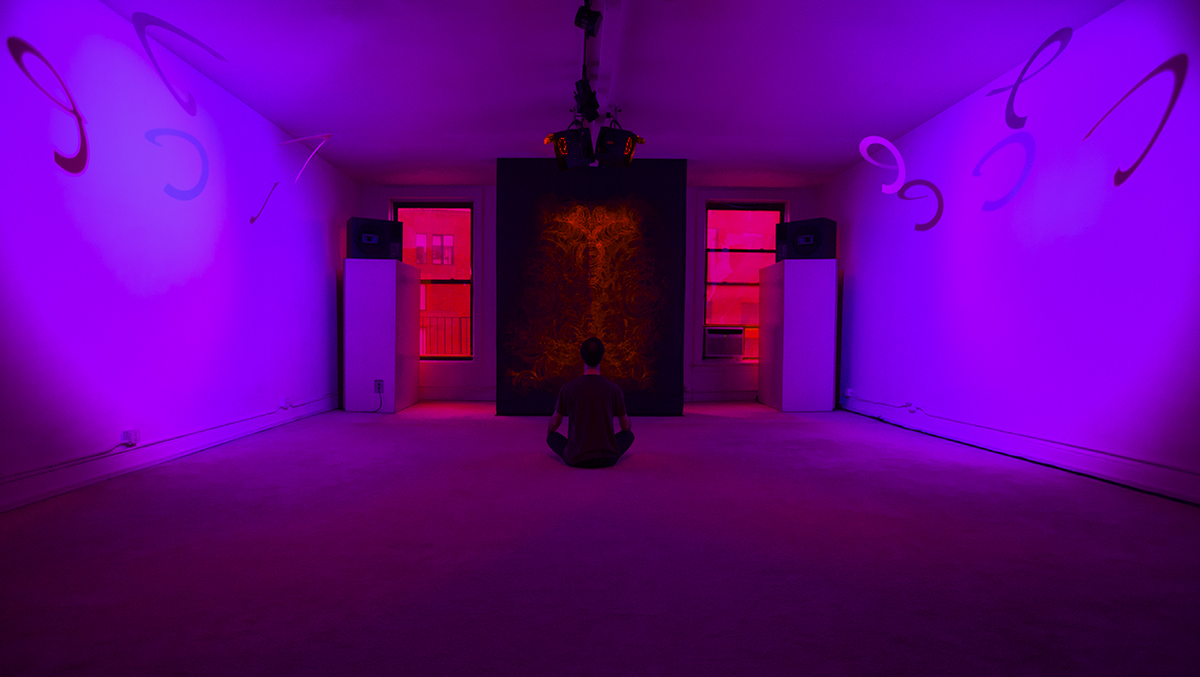
La Monte Young, Marian Zazeela, Jung Hee Choi Dream House, 2023, copyright © Jung Hee Choi 2023.
LA MONTE YOUNG MARIAN ZAZEELA JUNG HEE CHOI
DREAM HOUSE
SOUND AND LIGHT ENVIRONMENT
a time installation
measured by a setting of continuous frequencies in sound and light
Extended exhibition at MELA Foundation
Hours: Wednesday - Saturday, 2 PM - 10 PM
MELA Foundation
275 Church Street, 3rd Floor, New York
T 917 603 9715
www.melafoundation.org
Admission: $10.00
Dream House, a
collaborative Sound and Light Environment, is presented in an extended exhibition by La Monte Young,
Marian Zazeela and Jung Hee Choi at MELA Foundation, 275 Church Street, 3rd Floor. The long-term
Dream House
exhibition opened in Fall 1993; it will continue for this season through June 21, 2027.
The current Dream
House installation offers visitors a distinctive
experience of sound and light through the ongoing, simultaneous collaborations of La Monte Young,
Marian Zazeela (1940–2024), and Jung Hee Choi. Two sound environments—Young’s
The Base 9:7:4 Symmetry in Prime Time and Choi’s The
Tone-field—merge in an intricate interplay of
tonal relationships. Young’s sound environment remains constant, while Choi’s unfolds
through continuous transformation, positing the complementarity of opposites in counterpoint to
Young’s emphasis on unchanging constancy. Each sound environment retains its distinct sonic
structure within the Main and East galleries. The transitional acoustics of the entrance passageway
allow Young’s and Choi’s frequencies to interweave, bringing the two sound environments
into dialogue with Zazeela’s neon light sculpture, Dream House Variation I.
The light environment includes three works by Zazeela: Imagic Light, Magenta Day / Magenta Night, and Dream House Variation
I, all of which were specifically designed for the MELA
Dream House site. Zazeela describes Imagic
Light: “Installations of Light consist of precisely
positioned pairs of colored lights focused on symmetrically arrayed pairs of white aluminum mobile
sculptures, causing the projection of colored shadows on the ceiling or walls of a room. Each mobile
reflects the color of that portion of the spectrum represented by the light source focused directly on
it, while the colors of the shadows cast by each mobile appear as the complement of the projected
color mixed with the color of the paired light source focused on the adjacent mobile, all tempered by
the eye's adaptation to the overall color field. Light and scale are manipulated in such a way that
the colored shadows, in their apparent corporeality, can become virtually indistinguishable from the
mobile forms, engaging the viewer in a continuing dialogue between reality and
illusion.”
Simultaneously, Choi presents two light works in an evolving
configuration. In the main gallery, her Light Point
Drawings Nos. 28 and 29 have been newly configured in
response to Zazeela’s Magenta Day / Magenta
Night, bringing the two artists’ explorations of
light and color into a shared field of perception. In the East Gallery, she presents Color (Abyss/Twitch): live realization v.3. This piece, offering multiple modalities of a single property, signifies
the phenomenology of experience in constructing an evolving sense of reality. The composed video
element combined with the Twitch live feed is projected onto a reflective wall and onto a fleeting
smoke released by burning incense. The incomplete and fragmented projections over the incense smoke
deconstruct the representational construction of the livestream, apparently conveying no perceivable
information, meaning, or objective basis for intrinsic value. Although the smoke causes the
superimposed projections to constantly transform, an observable image or text transiently suspended on
the smoke occasionally emerges, evoking an epiphanic sense of spatial awareness.
La Monte Young presents The
Base 9:7:4 Symmetry in Prime Time When Centered above and below The Lowest Term Primes in The Range
288 to 224 with The Addition of 279 and 261 in Which The Half of The Symmetric Division Mapped above
and Including 288 Consists of The Powers of 2 Multiplied by The Primes within The Ranges of 144 to
128, 72 to 64 and 36 to 32 Which Are Symmetrical to Those Primes in Lowest Terms in The Half of The
Symmetric Division Mapped below and Including 224 within The Ranges 126 to 112, 63 to 56 and 31.5 to
28 with The Addition of 119, a periodic composite sound
waveform environment created from sine wave components generated digitally in real time on a
custom-designed Rayna interval synthesizer. Young's sound environment is composed of frequencies tuned
to the harmonic series between 288 and 224, utilizing numbers with factors of only 9, or those primes
or octave transpositions of smaller primes that fall within this range. The interval 288/256 reduces
to a 9/8 interval as does the interval 252/224. Thirty-two frequencies satisfy the above definition,
of which seventeen fall within the range of the upper, and fourteen fall within the range of the lower
of these two symmetrical 9/8 intervals. Young has arranged these thirty-one frequencies in a unique
constellation, symmetrical above and below the thirty-second frequency, the center harmonic 254 (the
prime 127 x 2). At the opening of the 1993 Dream
House installation, Young wrote: "This is my newest and
most radical sound environment; the Rayna synthesizer has made it possible to realize intervals that
are derived from such high primes that, not only is it unlikely that anyone has ever worked with these
intervals before, it is also highly unlikely that anyone has ever heard them or perhaps even imagined
the feelings they create."
In the concurrent sound environment, Choi's The Tone-field: perceptible arithmetical relations in a cycle of eight
Indian raga scale permutations, 23 IX 23 – 26 VI 21, New York converts the East Gallery space into an audibly perceptible number-field
that orbits through eight modal scales based on the ancient raga systems of India. The 24-hour cycle
of The Tone-field will be recalculated daily to create a modal scale that is appropriate for
the time of day corresponding to the movement of the Sun in New York. Choi writes:
“The Tone-field is a time-and-space-specific sound environment where the arithmetic/musical
structure and space are concomitant such that the space itself becomes the musical scale. The
listener’s body is completely enveloped by sound and shares its dimensions with the numerical
structure of the present intervallic ratios. Any continuous movement of one’s body causes a
continuous modulation of the chords in the space.”
Young and Zazeela write: “The Dream House was first
conceived of in 1962 and sound and light environments were installed in Young and Zazeela’s
studio in the mid-‘60s. The July 1969 sound and light environment at Galerie Heiner Friedrich,
Munich, was the first public short-term Dream House.
Under a long-term commission from the Dia Art Foundation
(1979-85), Young and Zazeela collaborated on a Dream House
presentation at 6 Harrison Street, New York, set in a
six-story building with a nine-story tower featuring multiple interrelated sound and light
environments, exhibitions, performances, research facilities and archives.”
MELA Foundation Dream House
Sound and Light Environment at 275 Church Street, New
York, now in its thirty-third year, is our longest installation to date. Since 1969, over 40 various
incarnations of site-specific sound and light environment installations have been presented worldwide.
The Regenbogenstadl Dream House in Polling, Bavaria, opened in 2000 and is intended to exist in perpetuity.
It has become very highly evolved, presenting a wide range of Dream House elements. The
MELA Dream House and Regenbogenstadl Dream
House both demonstrate the eternal evolution of the
Dream House, a
work ‘with a life and tradition of its own’ continuing into time with a capacity to propel
itself by its own momentum.
Since 2015, Young, Zazeela and Choi, have collaborated on numerous sound
and light environments, including Dia Art Foundation, New York, 2015; MELA Dream House in New York from
2018 onwards; Galerie l'elac in Lausanne, Switzerland, 2021 to 2022; Bundeskunsthalle, Bonn, Germany,
2022; Mexico City, Mexico, 2025 and Leeum Museum, Seoul, South Korea, 2026.